Why Your Back Still Hurts (And It's Probably Not Your Back)
Look, I've spent the better part of fifteen years in the building trade. I've watched blokes throw their backs out lifting something they've lifted a thousand times before, spend a week on anti-inflammatories, feel okay, and then do the exact same thing six months later. Same injury. Same spot. Same confusion about why it keeps happening.
Here's the thing nobody tells you: most of the time, your back isn't actually the problem.
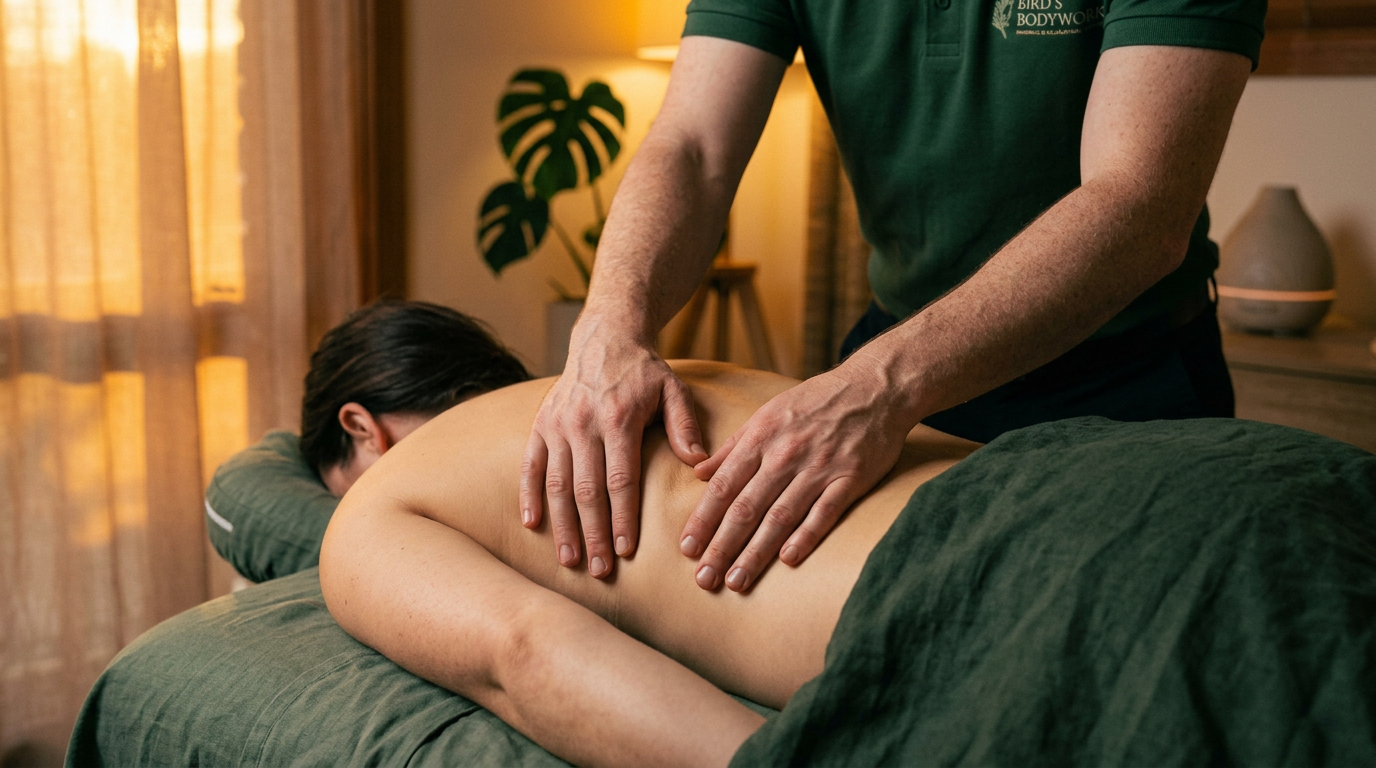
Your back is usually the victim, not the culprit
When your lower back is screaming at you, it feels pretty obvious that your lower back is where the issue lives. Makes sense. That's where it hurts. But the human body is a bit sneaky about this — pain shows up in one place while the actual cause quietly sits somewhere else entirely, laughing at you.
Lower back pain is one of the most common reasons people book in with me at Bird's Bodywork, and nine times out of ten, when I start working through what's actually going on, the back itself is the last place I end up spending my time. Usually it's:
Tight hip flexors. If you're sitting down for most of the day — at a desk, in a truck, on a machine — your hip flexors are in a shortened position for hours at a stretch. Over time they get tight and they pull on your lower back like a dog on a leash. Your back isn't failing. It's just getting yanked around.
Weak glutes. Your glutes are supposed to do a lot of the heavy lifting — literally. When they're not firing properly, your lower back picks up the slack. It's not built for that job and it lets you know about it.
Thoracic stiffness. The mid-back is where a lot of people seize up without realising it. When your upper and mid back stop moving properly, the lower back has to compensate for that lost movement. More load. More pain.
The point is — where it hurts and where the problem is are often two completely different postcodes.
Why it keeps coming back
This is the bit that trips most people up. You do something about the pain — rest, heat pack, a few ibuprofen, maybe a stretch you found on YouTube — and it settles down. You feel fine. You go back to doing exactly what you were doing before. And a few weeks or months later, there it is again.
That's because you treated the symptom and left the cause completely alone.
The tight hip flexors are still tight. The glutes are still not doing their job. The mid-back is still stiff. Nothing actually changed. The pain just went quiet for a while.
This is especially common in physical workers and people who train hard. Your body is pretty good at compensating and pushing through — that's what it's built to do. But it's keeping score, and eventually the bill comes due.
What actually helps
Genuine remedial massage — the kind that includes a proper assessment before anyone touches anything — works on finding the actual source of the problem and doing something about it. Not just running through the sore spots and hoping for the best.
When someone comes in to see me with lower back pain, I'm not just working on their lower back. I'm looking at what's tight, what's weak, what's not moving the way it should, and where the real load is sitting. Sometimes we spend most of the session on hips and glutes and the person walks out wondering why I barely touched their back. Then they message me a few days later because they feel significantly better. That's the job.
Does massage fix everything? No. If there's something structural going on — a disc issue, nerve involvement, something that needs imaging — I'll tell you and point you in the right direction. I work out of a physio practice and there's no shortage of people to refer to if that's what's needed. But in my experience, the majority of ongoing lower back pain that people have just quietly accepted as part of their life responds really well to proper hands-on treatment.
The bit I keep saying on the table
Your body spent a long time getting to this point. It's probably not going to sort itself out in one session. But it's also not going to get better if you keep doing nothing.
Most people I see with chronic lower back pain have been carrying it around for months, sometimes years, before they book in. They've just decided this is what their back is like now. It doesn't have to be.
If your back's been giving you grief and you've tried everything except actually getting it properly looked at — that's probably the next step.
Book a remedial massage in Camden Haven Area at Bird's Bodywork — online, takes two minutes.